
Attic Insulation Types Compared: Fiberglass vs. Cellulose vs. Spray Foam
Attic insulation plays a critical role in regulating temperature, reducing energy consumption, and protecting structural components from moisture-related damage. While many homeowners understand that insulation matters, fewer understand that not all insulation materials perform the same under real-world conditions.
Choosing the correct insulation type requires evaluating thermal resistance (R-value), air sealing capability, moisture behavior, installation method, and long-term durability.
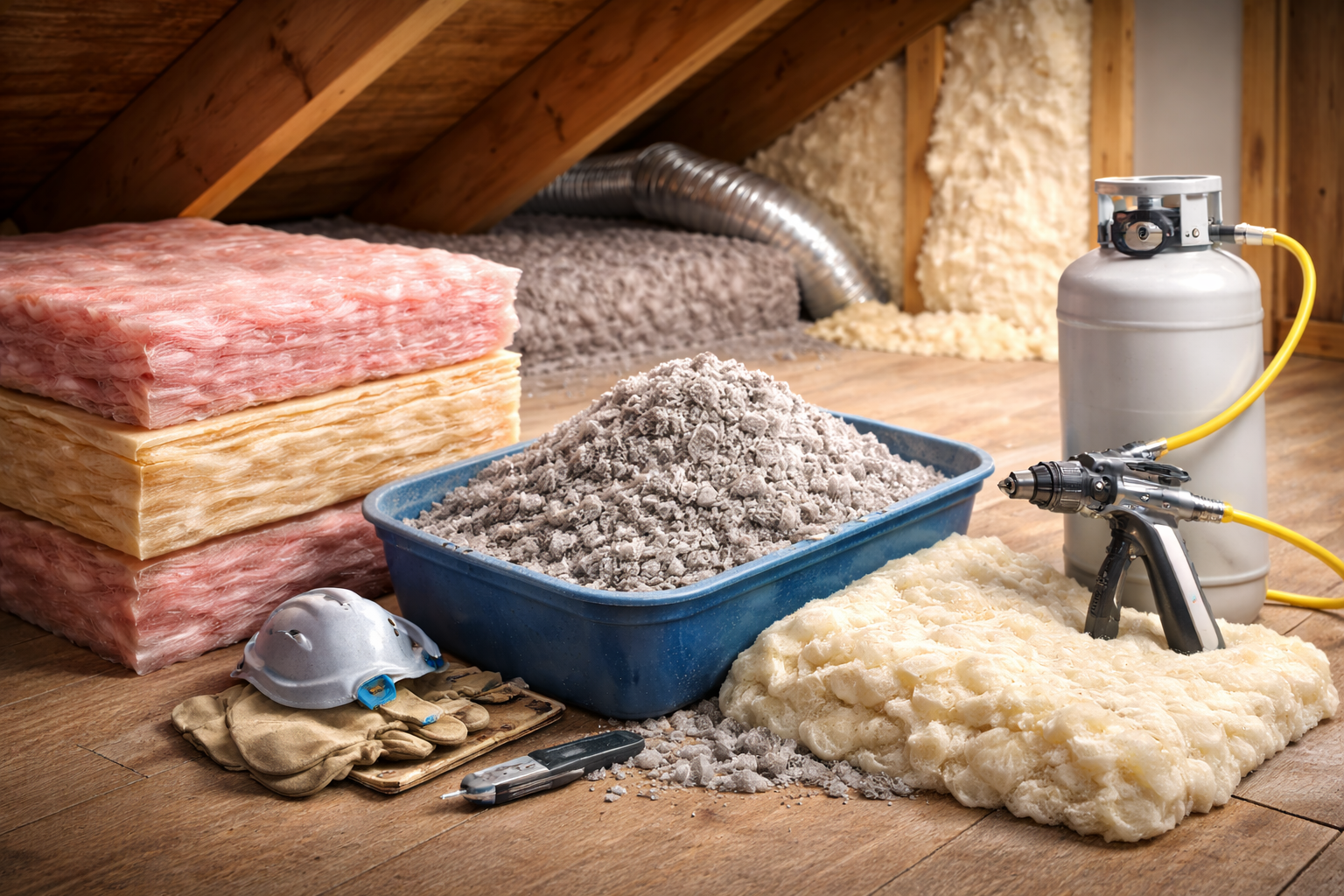
This article provides a technical comparison of the three most common attic insulation materials: fiberglass, cellulose, and spray foam.
Understanding R-Value and Thermal Performance
R-value measures a material’s resistance to heat flow. Higher R-values indicate better insulating performance.
However, R-value alone does not determine overall system efficiency. Air leakage, compression, and installation quality significantly influence real-world results.
Typical attic R-value recommendations vary by climate zone but often range between R-30 and R-60.
Fiberglass Insulation
Overview
Fiberglass insulation is composed of fine glass fibers and is typically installed as batts or blown-in loose fill.
Thermal Performance
R-value per inch: approximately R-2.2 to R-3.8
Performs best when installed without compression
Sensitive to air movement
Fiberglass does not inherently stop airflow. If attic air sealing is not completed first, thermal performance decreases significantly.
Advantages
Cost-effective
Widely available
Non-combustible
Easy to install in open attic spaces
Limitations
Reduced performance when compressed
Can trap moisture if ventilation is poor
Requires separate air sealing
Fiberglass is often a suitable choice when budgets are limited and air sealing is handled independently.
Cellulose Insulation
Overview
Cellulose insulation is typically made from recycled paper products treated with fire retardants and installed as dense-pack or blown-in material.
Thermal Performance
R-value per inch: approximately R-3.2 to R-3.8
Performs better than fiberglass in reducing air movement when densely packed
Cellulose offers improved resistance to air infiltration compared to fiberglass due to its density.
Advantages
Higher density improves air resistance
Better sound dampening
More environmentally sustainable
Fills irregular cavities effectively
Limitations
Can settle over time if not installed properly
More susceptible to moisture absorption
Requires proper ventilation management
Cellulose often performs well in retrofits where irregular spaces must be filled thoroughly.
Spray Foam Insulation
Overview
Spray foam insulation is a polyurethane-based material that expands upon application. It is available in two primary types:
Open-cell
Closed-cell
Thermal Performance
Open-cell: R-3.5 to R-3.7 per inch
Closed-cell: R-6 to R-7 per inch
Closed-cell spray foam offers the highest R-value per inch among common attic insulation materials.
More importantly, spray foam provides both insulation and air sealing in one system.
Advantages
Superior air barrier
High R-value per inch
Reduces moisture infiltration
Strengthens structural framing (closed-cell)
Limitations
Higher installation cost
Professional installation required
More difficult to remove once applied
Spray foam is often selected for high-performance homes where air sealing and moisture control are top priorities.
Air Sealing Performance Comparison
| Material | Air Barrier Capability | Requires Separate Air Sealing |
|---|---|---|
| Fiberglass | Low | Yes |
| Cellulose | Moderate | Recommended |
| Spray Foam | High | No |
Air movement significantly impacts insulation effectiveness. In many cases, air leakage accounts for more energy loss than conductive heat transfer.
Moisture and Vapor Behavior
Moisture management is critical in attic assemblies.
Fiberglass allows moisture to pass through but does not prevent air-driven moisture transport.
Cellulose can absorb and release moisture but may degrade if chronically wet.
Closed-cell spray foam resists water intrusion and acts as a vapor retarder.
Improper moisture management can lead to:
Mold growth
Wood rot
Insulation degradation
Reduced R-value
Insulation selection should align with regional humidity conditions.
Cost Considerations
While pricing varies by region, relative cost comparisons typically follow this pattern:
Fiberglass: lowest upfront cost
Cellulose: moderate cost
Spray foam: highest upfront cost
However, lifecycle cost must also be considered. Higher initial investment may result in lower energy expenses over time.
Homeowners should evaluate:
Existing insulation condition
Air leakage severity
Climate zone
Long-term occupancy plans
Installation Variables That Affect Performance
Regardless of material type, improper installation reduces effectiveness.
Common issues include:
Gaps in coverage
Compression of batts
Inadequate depth
Lack of air sealing before installation
Blocking soffit ventilation
Even high-performance materials underperform when installation standards are not followed.
When to Choose Each Type
Fiberglass May Be Appropriate If:
Budget is limited
Attic air sealing is completed separately
Access is easy
Climate is moderate
Cellulose May Be Appropriate If:
Filling irregular cavities
Improving sound reduction
Retrofitting older homes
Seeking improved air resistance over fiberglass
Spray Foam May Be Appropriate If:
Maximizing air sealing
Converting attic to conditioned space
Reducing humidity infiltration
Seeking highest R-value per inch
Final Evaluation
There is no universally “best” attic insulation material. The optimal choice depends on performance goals, climate conditions, installation quality, and budget.
In many cases, performance differences are less about material selection and more about air sealing, ventilation strategy, and proper installation practices.
Homeowners seeking maximum energy efficiency should evaluate insulation as part of a comprehensive building envelope strategy rather than a standalone upgrade.